Best Puzzle Feeders for Cats Who Eat Too Fast (2026 Picks)
If your cat inhales meals, a puzzle feeder can slow eating and add daily enrichment. These are the best starter, flat, digging, and challenge feeders.
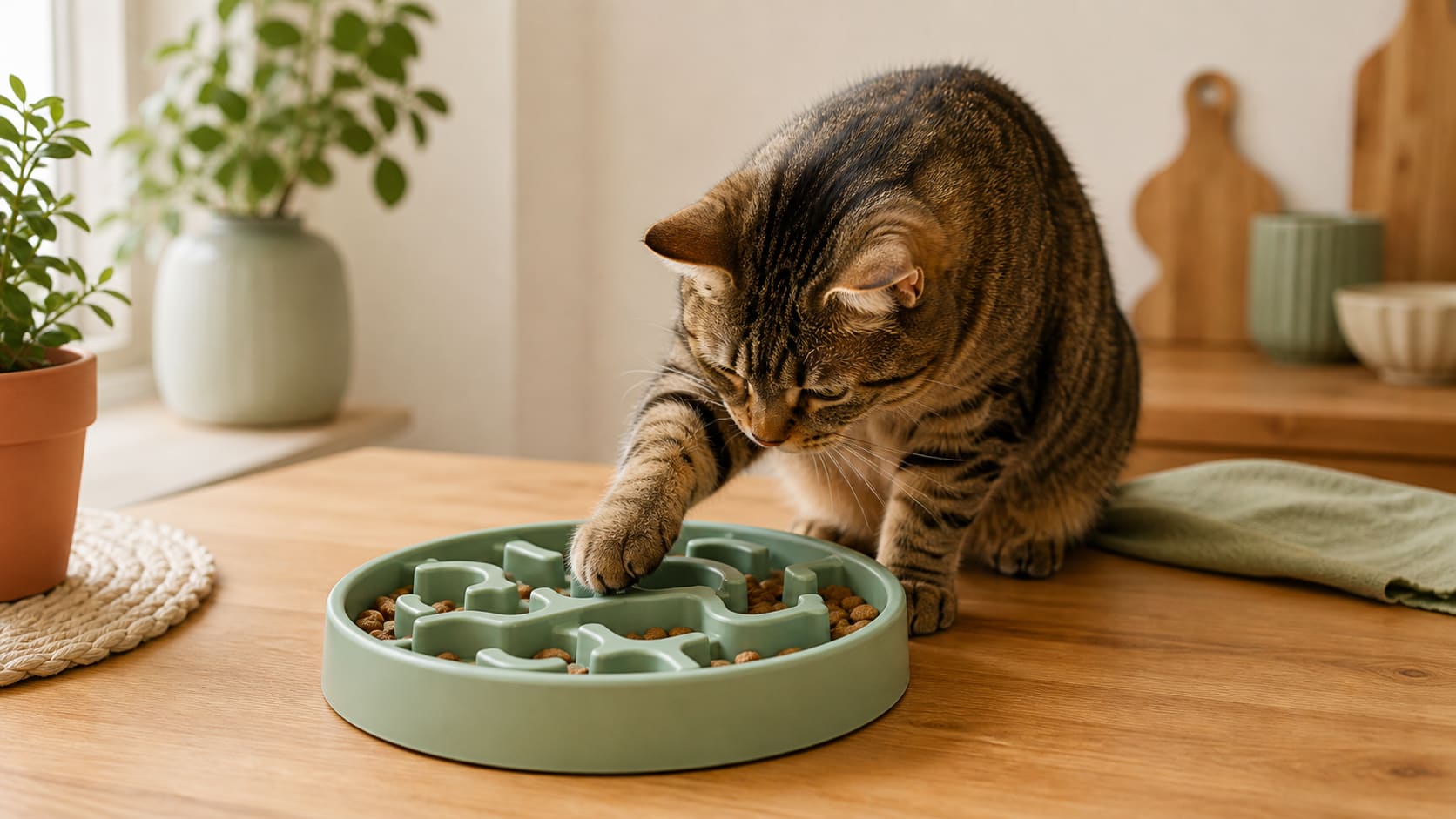
Your cat inhales the food, walks two feet away, and throws it back up.
Or she finishes the bowl in under a minute, then spends the next hour staring at you like she has not eaten in days.
This is one of the most common indoor cat problems. The bowl is convenient for humans, but it removes almost all of the movement, searching, and problem solving that feeding can provide.
That is where puzzle feeders help.
Why Cats Eat Too Fast
Cats are built to eat small meals across the day. A natural hunting pattern involves searching, stalking, catching, eating, grooming, and resting.
A bowl collapses that whole sequence into thirty seconds. There is no work, no movement, and no problem to solve. Food appears, and a fast eater simply clears it.
The issue is not always hunger. Often, the meal is too easy and too short.
Fast eating can contribute to regurgitation, food fixation, and restless behavior after meals. If your cat eats quickly and vomits often, check with your vet too, especially if the pattern is new.
What helps: Make the meal slower and more interesting without making it impossible. Start with a simple feeder before moving to harder puzzles.
What Puzzle Feeders Actually Do
A puzzle feeder is a foraging tool.
It holds food in a way that makes your cat move, paw, roll, fish, or search to get it out. That can turn a very short meal into five to fifteen minutes of focused activity.
Food puzzles are widely used as feline enrichment because they support natural feeding behavior and give indoor cats a daily problem to solve. They are not magic, but they are one of the easiest ways to add mental work to a routine your cat already has.
A better meal is not just slower. It gives the brain something to do.
If your cat also shows boredom patterns like biting during petting or knocking objects off surfaces, feeding enrichment is a useful place to start.
What to Look For
Not all puzzle feeders are equally useful.
Kibble compatibility: Most puzzle feeders work best with dry food. If you feed wet food, choose simple shapes that are easy to wash.
Appropriate difficulty: Start easier than you think. A frustrated cat will walk away.
Easy cleaning: If the feeder is annoying to wash, it will end up in a drawer.
Stability: Feeders that slide across the floor can frustrate cats faster than they engage them.
What helps: Pick one easy feeder first, use it for a small portion of the meal, then increase the amount once your cat understands the game.
The Picks
PetSafe SlimCat: Best for Beginners
PetSafe SlimCat is a hollow ball with adjustable holes. You fill it with kibble, and your cat bats it around to release pieces one at a time.
It is simple, which is exactly why it works as a first puzzle feeder. Most cats understand the basic idea quickly. The adjustable openings let you make it easier or harder as your cat gains confidence.
The limitations are clear: it is dry food only, it can roll under furniture, and some cats lose interest once the novelty fades. But it is inexpensive and low risk.
Best for: First time puzzle feeders, high energy cats, and homes where simplicity matters.
TRIXIE Cat Activity Flip Board: Best Flat Feeder
TRIXIE Cat Activity Flip Board is a low tray with small compartments your cat has to paw, nudge, or uncover.
The flat shape makes it stable and approachable. It is a good step up from a rolling ball because your cat has to solve a few different small problems instead of repeating one movement.
It will not slow experienced cats as much as a harder feeder. Once they memorize the layout, the session gets shorter. That is fine. Rotate it with another feeder rather than expecting one tool to stay interesting forever.
Best for: Cats that like to use their paws, owners who want a stable feeder, and cats ready for a slight challenge.
Catit Senses 2.0 Digger: Best for Pawing Cats
Catit Senses 2.0 Digger uses vertical tubes that your cat has to fish food out of with one paw.
That digging motion is satisfying for cats who already paw at water glasses, gaps, boxes, or couch cushions. It also creates a more focused feeding session than a simple bowl.
The tubes can be too narrow for some larger cats, and it is still mainly a dry food feeder. But for paw motivated cats, it is a strong middle difficulty option.
Best for: Cats that fish and paw at objects, medium difficulty feeding, and rotating with flatter puzzle boards.
Cat Amazing Puzzle Feeder: Best Challenge Feeder
Cat Amazing Puzzle Feeder is a cardboard box feeder with multiple openings and difficulty levels.
It gives experienced cats more to solve than a single mechanism feeder. The different holes and compartments keep the session varied, and the cardboard texture appeals to cats who like to scratch or grip while they work.
The tradeoff is durability. Cardboard is not dishwasher safe, and heavy daily use will wear it down. Keep it dry and replace it when it starts to soften or tear.
Best for: Cats that have mastered easier feeders, clever indoor cats, and owners who want a genuine problem solving meal.
How to Introduce a Puzzle Feeder
The most common mistake is making the first session too hard.
Do not put a full meal into a complex feeder on day one. Your cat may get frustrated, give up, and decide the feeder is not worth using.
Start with visible food. Let your cat succeed quickly. Then hide the food more gradually.
Try this simple ramp up:
- Day 1 and 2: Put a few treats or kibble pieces on top of the feeder.
- Day 3 and 4: Put a small portion into the easiest openings.
- Day 5 onward: Add more food and increase difficulty slowly.
Once your cat understands the setup, most cats can work through a meal in several focused minutes instead of emptying a bowl immediately.
For more daily enrichment beyond feeding, our guide to indoor cat enrichment ideas covers quick setups at every effort level. The interactive toy roundup pairs well with puzzle feeding if your cat needs more movement too.
The Bottom Line
A puzzle feeder is one of the highest return upgrades for an indoor cat.
Start easy. Let your cat win. Increase difficulty only after she understands the game.
The bowl is convenient, but it is often the least interesting version of a meal. Puzzle feeders give that meal a job again.
Keeping track of how your cat’s energy and behavior shifts after adding puzzle feeding? We’re building CatPlay, a simple app for logging daily play and feeding habits so you can spot what’s actually working.
Sources
This article cites 3 sources in the text. They are linked below.
- Food puzzles for cats: Feeding for physical and emotional wellbeing (Journal of Feline Medicine and Surgery)
- Feline Environmental Needs and Enrichment (MSPCA-Angell)
- Setting Up the Environment for Success (FelineVMA)
Common questions
Are puzzle feeders good for cats who eat too fast?
Yes, many cats benefit from puzzle feeders because they make food take longer to access and add mental work to mealtime. Start with an easy feeder so your cat does not get frustrated.
Can puzzle feeders replace a bowl completely?
For many dry food meals, yes. Wet food can work too, but you need a feeder that is easy to wash and has wider channels or a lick style surface.
What is the easiest puzzle feeder for a beginner cat?
A rolling ball feeder like PetSafe SlimCat is usually the easiest first step because the action is simple: bat the ball, get a few pieces of kibble.
The Indoor Cat Enrichment Starter Plan
A simple download with play, food puzzle, and routine ideas you can use this week.
No spam. Unsubscribe anytime. We respect your inbox.