Mental Stimulation for Cats: 12 Ways to Exercise the Brain
Physical play only tires half of your cat. Here are 12 ways to give an indoor cat real mental stimulation, from foraging puzzles to scent work and training.
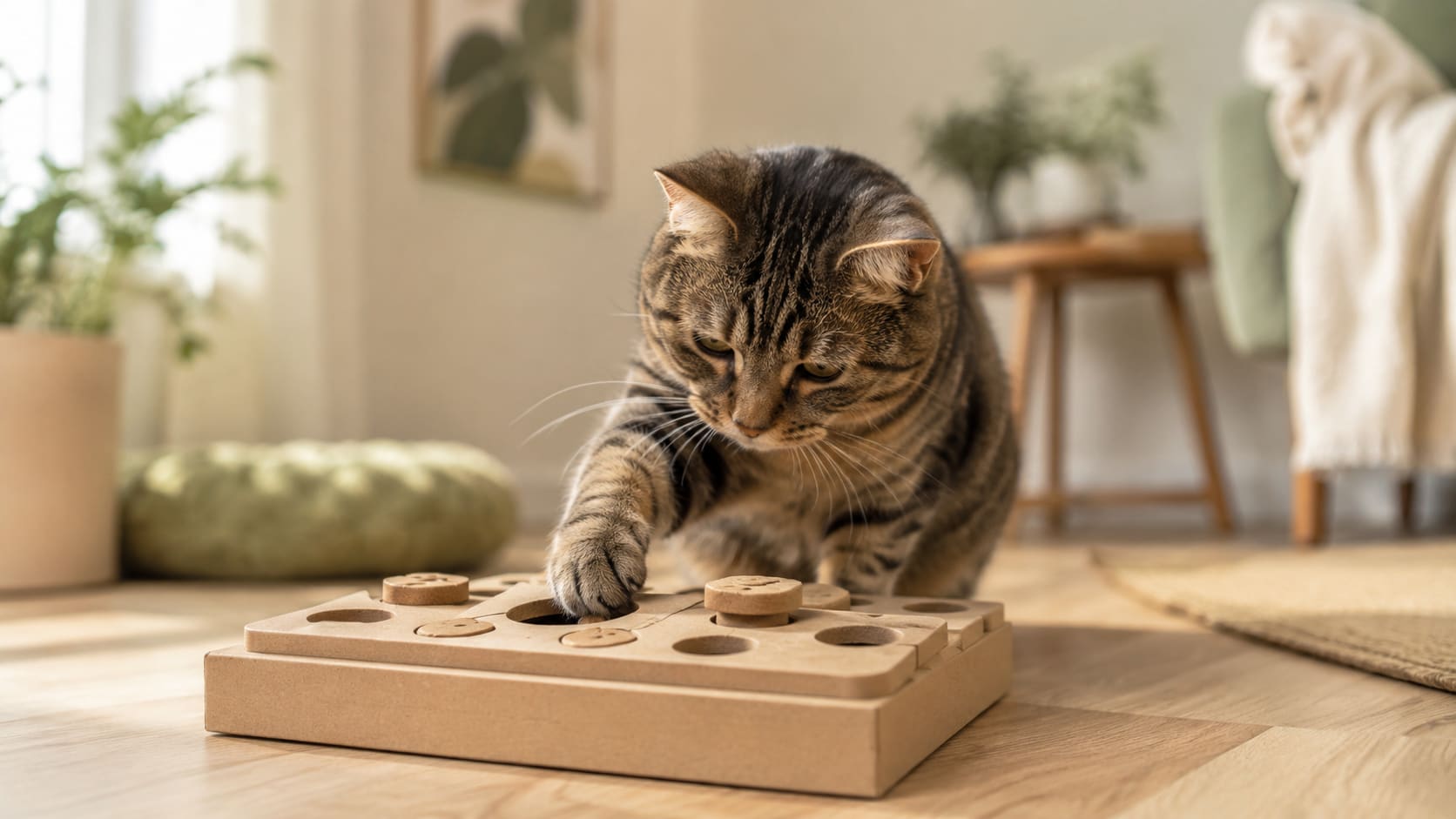
You wore your cat out with the wand toy. Twenty minutes of flat-out chasing, the cat is panting, you are proud of yourself, and an hour later they are pacing the hallway again looking for trouble.
Physical exercise only tires half of your cat. The other half, the part that decides whether your cat feels genuinely satisfied or just bored on a loop, is the brain. A cat in the wild spends most of its waking hours not running but figuring things out: where the prey is, how to reach it, when to wait. Take that problem-solving away and you get a cat with nothing to think about, which is its own kind of restlessness.
Here are twelve ways to exercise the part of your cat that the wand toy never touches.
1. Make Them Forage for a Meal
The single highest-impact change you can make is to stop serving food in a bowl. A bowl is solved in ninety seconds. A foraging puzzle turns the same food into ten or fifteen minutes of nudging, pawing, and thinking.
This is not a gimmick. Working for food is the most natural mental task a cat has, and it scales from beginner to expert.
What helps: A maze-style puzzle like the Cat Amazing hides treats in a cardboard labyrinth your cat has to reason through. It is a genuine first puzzle, not a toy, and most cats stay engaged because the difficulty feels real.
For cats who need a little movement with the puzzle, a doorway setup can work well as a short session. The NHCASURUE Hanging Door-Frame Treat Dispenser combines a treat dispenser with feathers and a bell, which makes the reward something your cat has to investigate and paw at rather than simply eat. Use it first while you are home, check that the attachment is secure, and inspect hanging toys regularly.
2. Build a Sliding-Tile Brain Game
Once your cat understands foraging, raise the difficulty. Activity boards with sliders, lids, and wells ask the cat to use different paw movements to reach each reward, which keeps the puzzle from becoming automatic.
The slow ramp in difficulty is the point. A puzzle your cat has fully memorized is no longer mental work.
What helps: The TRIXIE Cat Activity Flip Board combines several mechanisms in one board, so your cat has to switch tactics rather than repeat one trick.
3. Turn Mealtime Into Scent Work
Cats experience the world through their nose far more than we do, and scent searching is mentally tiring in a quiet, satisfying way. A snuffle mat hides kibble in folds of fabric your cat has to sniff out and work free.
It is also the gentlest option for older cats or cats recovering from surgery who need brain work without much movement.
What helps: A snuffle mat gives a cat a low-effort, high-focus search that stretches a small handful of food into real engagement.
4. Slow the Lick Down
A lick mat spread with a thin layer of wet food or a cat-safe topper turns a thirty-second snack into a few minutes of focused, repetitive licking. The act is self-soothing as well as occupying, which makes it a useful tool for cats that get anxious when alone.
What helps: A textured LickiMat suctions to the floor or a wall and makes your cat work the food out of the grooves, stretching the experience and calming them at the same time.
5. Teach a Trick
Cats are absolutely trainable, and most people never try. Clicker training a simple behavior, sit, target a hand, high-five, gives your cat a structured problem to solve with a clear reward. Five minutes is a full session.
Training is some of the densest mental work you can offer, because the cat has to form and test a theory about what earns the treat.
6. Rotate the Toys, Don’t Add Them
Novelty is mental stimulation. A toy that has sat out for two weeks is, to your cat, part of the floor. Keep three or four toys in play and box the rest, then swap weekly. The same toy comes back genuinely new.
Stimulation is not about owning more. It is about showing less at a time. For the full version of this idea, see our guide to indoor cat enrichment ideas.
7. Set Up “Cat TV”
A window with a view is passive mental enrichment that runs all day. Watching birds, leaves, and movement gives your cat a constant stream of things to track, stalk, and chatter at, with no effort from you.
A bird feeder stuck to the outside of the glass turns an empty window into a live channel.
8. Hide Food Around a Room
Take part of a meal and tuck small portions in predictable “find spots” around a safe room, on a cat tree shelf, behind a table leg, in a low box. Your cat now has a reason to patrol and search instead of sleeping the afternoon away. This costs nothing and rebuilds the hunt-and-find loop cats are built for.
9. Give Them a Box to Investigate
A plain cardboard box is one of the most reliably interesting objects in any home. Cut a few paw holes, drop a toy or a treat inside, and you have a sensory puzzle. The appeal is real: enclosure, novelty, and a hidden reward to fish out.
If you want a dozen more along these lines, our DIY cat enrichment guide is built entirely from things you already own.
10. Play to a Finish, Not to Exhaustion
Mental satisfaction in play comes from completing the hunt, not from how long it lasts. Let your cat actually catch the toy at the end of a session, then offer a small meal. That sequence, hunt, catch, eat, groom, sleep, is what leaves a cat genuinely settled rather than wound up.
If your cat seems uninterested in toys entirely, the cause is usually fixable, and we cover it in why your cat won’t play with toys.
11. Add Vertical Territory
Height is mental enrichment because it changes what your cat can observe and control. A cat that can survey a room from above has more to monitor and feels more secure doing it. Cat trees, shelves, and cleared windowsills all expand the mental map your cat gets to manage.
What helps: The Lynadri Cat Wall Shelves 5-in-1 is useful when the floor plan is already full. Steps, a small condo, a scratch area, and a post turn an empty wall into a route your cat can climb, patrol, and rest on. The important part is not owning shelves; it is creating a stable, secure path your cat actually wants to use.
12. Change One Thing on Purpose
Cats are creatures of habit, but small, controlled novelty keeps the brain awake. Move a scratching post, leave out a paper bag, swap which puzzle appears at breakfast. You are not redecorating, you are giving your cat one new thing to assess. Predictable routine plus tiny variation is the sweet spot.
The Minimum That Actually Works
You do not need all twelve. A genuinely well-stimulated cat usually has:
- One foraging meal a day instead of a bowl.
- Two short focused sessions, play in the morning, a puzzle or training in the evening.
- One passive channel running, a window view or a scatter feed.
- Weekly rotation so nothing goes stale.
That mix tires the half of your cat the wand toy never reaches, which is usually the half keeping you up at night. If you are not sure boredom is the issue in the first place, start with the signs your cat is bored.
Trying to work out which of these actually changes your cat’s day? We’re building CatPlay, a simple app for tracking your cat’s daily play and behavior so you can see what is working and what is not.
Sources
This article cites 3 sources in the text. They are linked below.
- Feline Environmental Needs and Enrichment (MSPCA-Angell)
- Indoor Pet Initiative — Cats (The Ohio State University College of Veterinary Medicine)
- Environmental Enrichment for Indoor Cats (Cat Friendly Homes)
Common questions
Is mental stimulation as important as physical exercise for cats?
Yes, and often more neglected. Cats are predators wired to solve problems to eat, so a cat that only runs but never has to think tends to stay restless. A mix of physical play and mental work leaves a cat more settled than either one alone.
How much mental stimulation does a cat need per day?
Most indoor cats do well with two short structured sessions, one in the morning and one in the evening, plus passive enrichment like a foraging meal or a window view running in the background. Ten to fifteen minutes of focused work is plenty for a single session.
How do I know if my cat is mentally understimulated?
Common signs are over-grooming, attention demanding, destructive behavior, eating too fast out of boredom, and waking you at night. A cat that gets enough mental work usually sleeps more soundly and pesters less.
The Indoor Cat Enrichment Starter Plan
A simple download with play, food puzzle, and routine ideas you can use this week.
No spam. Unsubscribe anytime. We respect your inbox.