Do Single Cats Get Lonely? Enrichment for One-Cat Homes
Does your only cat need a friend, or just more to do? Here is how to tell loneliness from boredom in a single cat, and how to enrich a one-cat home so they thrive.
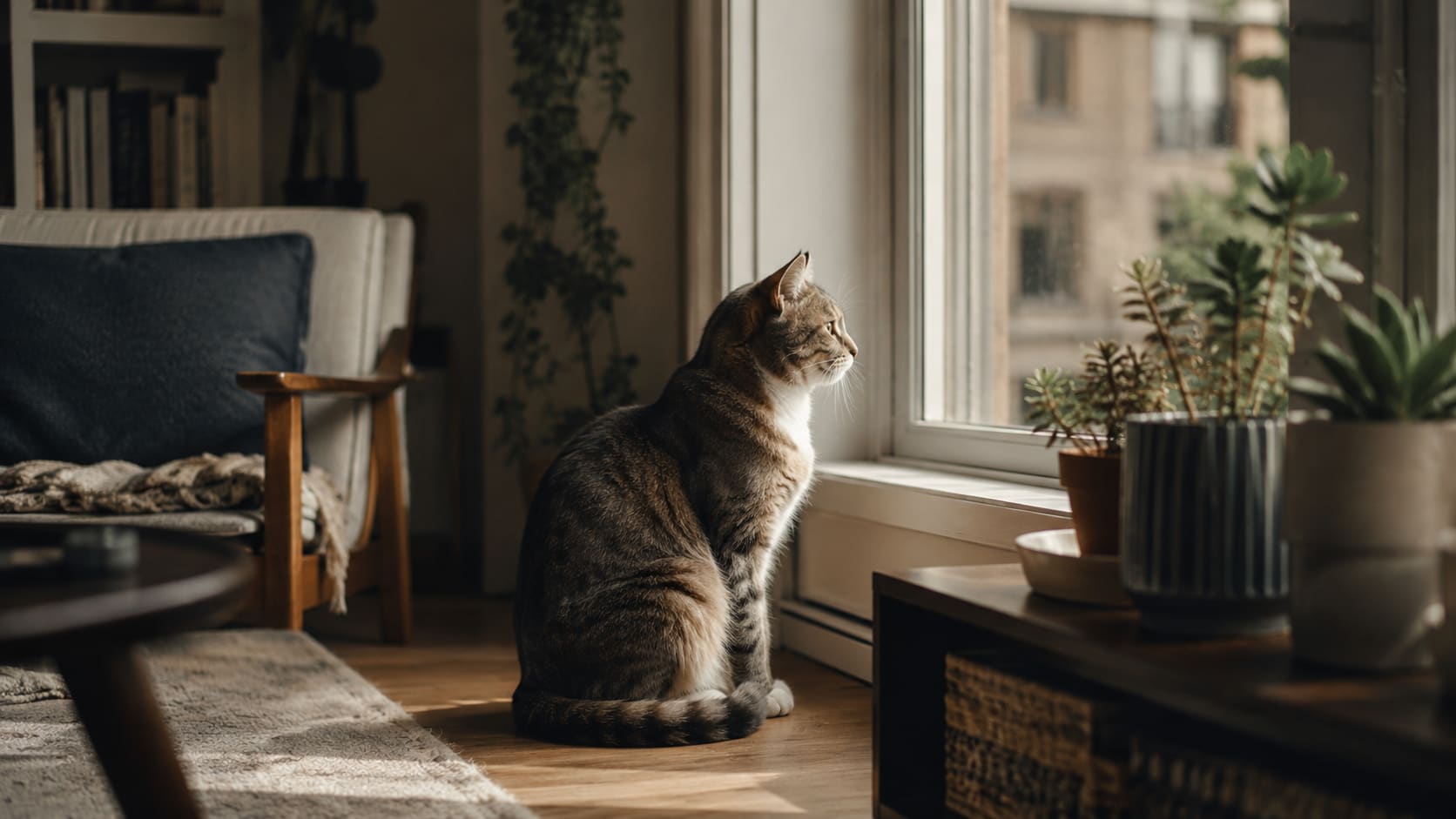
Every owner of an only cat has had the thought, usually while heading out the door: Is my cat lonely in here all day by themselves? It is a kind worry, and it sends a lot of people straight to the question of whether to adopt a second cat.
Before you do, it is worth knowing what the research and the behaviorists actually say, because the popular picture, that cats pine for feline company, is mostly wrong. Cats descend from a largely solitary ancestor. They are not pack animals, and many cats are genuinely content as the only cat in the home. What an only cat needs is not necessarily another cat. It is enough interaction, stimulation, and outlets to feel engaged. Loneliness in cats is far more often a stand-in for boredom and under-stimulation than a literal need for a companion.
So the real question is not “is my cat lonely?” but “is my cat engaged?” Here is how to tell, and how to build a one-cat home where a single cat thrives.
Loneliness or Boredom? Read the Signs
The two look similar, but they point at different fixes.
Boredom shows up whether or not you are home: restlessness, destructive behavior, over-grooming, eating too fast, waking you at night. It is a stimulation problem.
Loneliness tends to be tied specifically to you: clinginess, following you room to room, vocalizing when you leave or arrive, and seeming flat when you are gone. It is an interaction problem.
Most single cats who seem “lonely” are actually under-engaged, and the good news is that both problems respond to the same toolkit, more interaction and more to do. If you want to rule out illness as well, bored, lonely, or sick walks through telling them apart.
Make Your Interaction Time Count
For a single cat, you are the primary social partner, so the quality of your interaction matters more than in a multi-cat home. The fix is not spending every hour with your cat. It is making the time you do spend predictable and genuinely engaging.
Two short, structured play sessions a day, done like a real hunt with a catch at the end, do more for a single cat’s wellbeing than an entire afternoon of you being passively in the same room. Routine is part of the reassurance: a cat that knows play reliably comes at certain times relaxes between them.
Give Them Ways to Burn Energy Alone
A one-cat home has no second cat to wrestle and chase, so the self-play layer matters more. The energy a companion might have absorbed has to go somewhere, and that means outlets your cat can use without you.
What helps: An automatic toy like the SmartyKat Loco Motion gives your cat short bursts of solo chasing on a timer through the day. And for a high-energy only cat with no playmate to run with, an exercise wheel like the One Fast Cat provides a real outlet for the kind of flat-out running a sibling might otherwise have prompted.
Feed the Brain, Not Just the Body
A single cat has more quiet hours to fill, so mental work carries extra weight. Foraging puzzles turn meals into a solo activity that occupies your cat long after a bowl would be empty, filling the gaps a companion’s company might have filled.
What helps: A puzzle feeder like the Catit Senses Digger makes your cat work food out of tubes with its paws, a genuinely absorbing solo task that stretches mealtime into real engagement. For more along these lines, see mental stimulation for cats.
Bridge the Gap While You Are Out
Part of what reads as loneliness is simply the long unbroken stretch of your absence. You can break it up, and reassure yourself at the same time, with a way to check in and create a small midday event.
What helps: A pet camera with a treat dispenser lets you watch in, talk, and toss a treat from your phone, so your only cat gets a surprise mid-afternoon and you get to see whether they are actually distressed or just napping peacefully. For most owners of single cats, seeing the calm is half the relief.
Should You Get a Second Cat?
Sometimes the answer genuinely is yes, but it deserves more thought than “my cat seems lonely.” Consider a companion if your cat is clearly social, young and high-energy, and still struggling after you have improved the interaction and enrichment. A well-matched second cat can absorb energy and provide company a human cannot.
But go in clear-eyed. A mismatched pairing, wrong ages, wrong temperaments, a rushed introduction, often creates more stress, not less: territorial tension, resource guarding, and two unhappy cats instead of one bored one. If you do add a cat, introduce them slowly over days, not minutes. A second cat is a real solution for the right cat, not a default fix for a quiet afternoon.
The Bottom Line
Most single cats are not lonely for another cat. They are under-engaged, and that is something you can fix without adopting anyone. Reliable daily play, self-play outlets, food puzzles, a window to watch, and a way to check in during the day will transform how a one-cat home feels, for both of you.
Build that foundation first. If your cat is still clearly struggling after it is in place, then a companion becomes a thoughtful next step rather than a guess. For the full set of quick wins to start with, see 20 indoor cat enrichment ideas.
Want to know whether your only cat is genuinely thriving or just coping? We’re building CatPlay, a simple app for tracking your cat’s daily play and behavior so you can see what is actually keeping them engaged.
Sources
This article cites 3 sources in the text. They are linked below.
- Feline Environmental Needs and Enrichment (MSPCA-Angell)
- What Your Cat Needs to Feel Secure (Cat Friendly Homes)
- Indoor Pet Initiative — Cats (The Ohio State University College of Veterinary Medicine)
Common questions
Do single cats get lonely without another cat?
Some do, but far fewer than people assume. Cats are not pack animals the way dogs are, and many are perfectly content as the only cat as long as they get enough interaction, play, and enrichment. True loneliness is more about a lack of engagement than a lack of another cat.
Should I get a second cat to keep my cat company?
Not as a default. A second cat can help a genuinely social, under-stimulated cat, but a mismatched pairing often creates stress, tension, and territorial problems. Try fixing the enrichment and interaction first, then consider a companion only if your cat is clearly social and still struggling.
How can I tell if my cat is lonely or just bored?
Loneliness tends to be tied to you, clinginess, following, vocalizing when you leave or return. Boredom shows up as restlessness, destructive behavior, and over-grooming regardless of whether you are home. The two overlap, and both usually improve with more structured interaction and enrichment.
The Indoor Cat Enrichment Starter Plan
A simple download with play, food puzzle, and routine ideas you can use this week.
No spam. Unsubscribe anytime. We respect your inbox.