How to Keep Your Cat Entertained While You're at Work (All-Day Plan)
A simple all-day routine to keep your cat busy while you're at work, using morning play, foraging meals, window views, and self-play toys that run without you.
You grab your keys, and there it is: the slow blink from the top of the sofa, the look that says you’re leaving again. Then you come home to a shredded roll of paper towels and a plant knocked onto the floor.
Those two things are connected.
A cat left alone all day is not lonely in the way we picture it. But the long, flat stretch between breakfast and your return is the part of the day most likely to curdle into boredom, and boredom is what gets redirected into your blinds, your counters, and your 3 AM sleep. The fix is not a guilty shopping spree. It is a simple routine that loads the day with small outlets, some before you leave and some that run on their own while you are gone.
Here is the all-day plan.
1. Drain the Tank Before You Leave
The single most useful thing you can do happens before you even put your shoes on.
Ten to fifteen minutes of real chase-and-pounce play in the morning gives your cat a full hunting sequence to complete. A cat who has “caught” something at 7 AM is a cat who eats, grooms, and sleeps through the quiet morning instead of inventing a project at 10.
A tired cat at breakfast is a calm cat at lunch.
What helps: A wand toy that mimics prey movement is the most reliable trigger for a full hunt. The Go Cat Da Bird flutters like a bird and pulls most cats into a genuine chase rather than a half-hearted swat.
2. Make Breakfast a Hunt, Not a Bowl
A bowl meal is over in ninety seconds. A foraging meal can stretch to fifteen minutes of nudging, pawing, and problem-solving.
Feeding at least part of the morning meal through a puzzle gives your cat work to do right as you head out the door, which bridges the gap between play and their first nap.
What helps: A rolling treat ball like the PetSafe SlimCat turns kibble into a slow hunt. If you want the full comparison of designs for fast and clever eaters, see our guide to the best puzzle feeders.
3. Set Up “Cat TV”
Ask any cat behaviorist about the cheapest high-impact upgrade for an indoor cat and you will hear the same answer: a window.
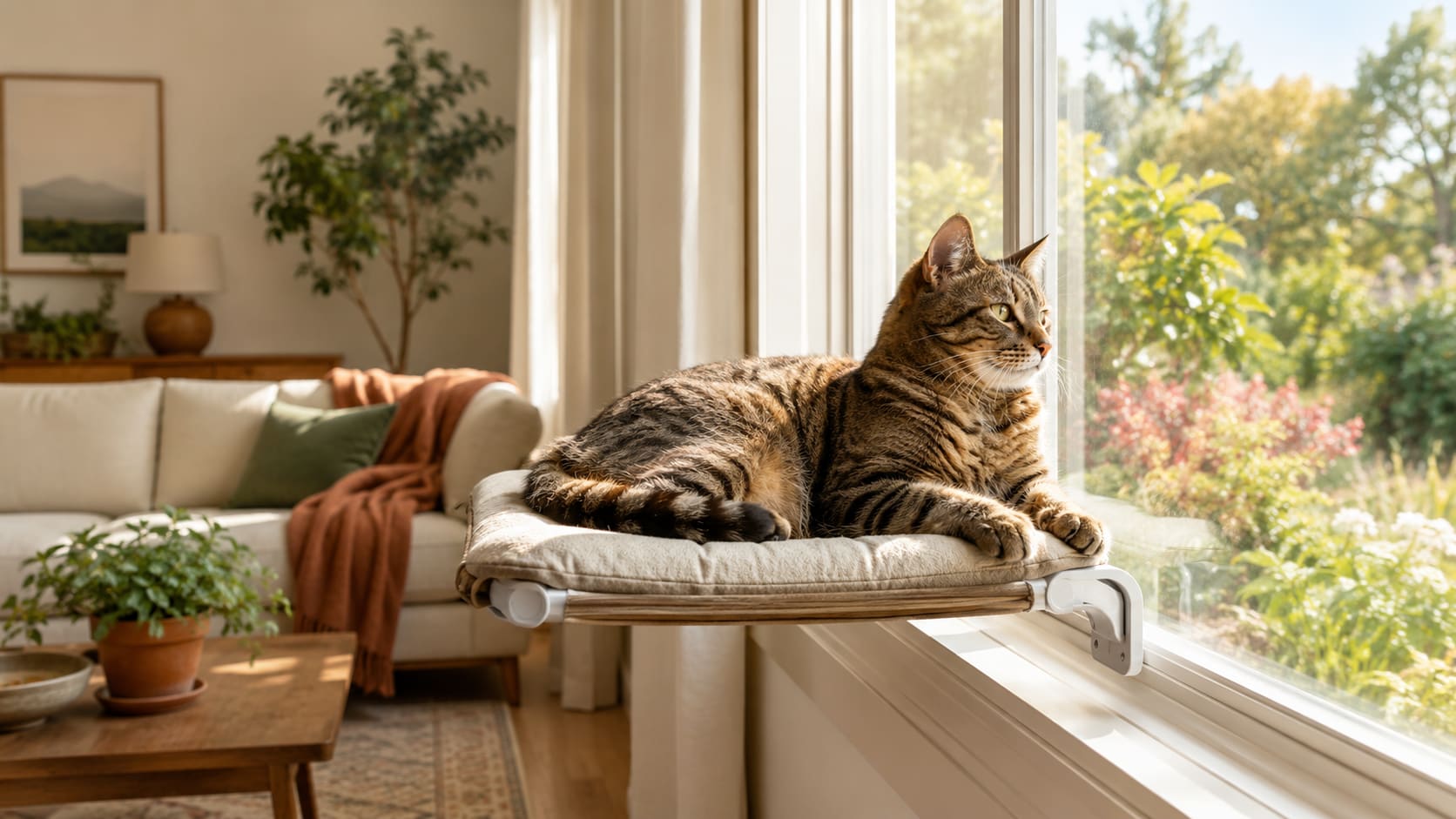
A perch with a view turns the outside world into hours of passive entertainment, what trainers half-jokingly call “Cat TV.” Add a bird feeder stuck to the glass and you have given your cat a reason to watch, chatter, and stalk all day, with zero effort from you.
What helps: A cat window perch with a clip-on bird feeder mounts with suction cups and creates a live nature channel right where your cat already wants to sit.
4. Leave Toys That Move on Their Own
The trouble with most toys is that they only work when you are holding them. Self-play toys solve the part of the day you are not there for.
Look specifically for toys with an automatic shut-off so they pulse on and off through the day rather than running flat in an hour. And a safety note: never leave anything with strings, or a laser, running unsupervised.
What helps: The SmartyKat Loco Motion moves a feather wand in unpredictable patterns and can be set to play in intervals for up to two hours, which spreads the stimulation instead of dumping it all at once.
For treat-based movement, start more cautiously. The NHCASURUE Hanging Door-Frame Treat Dispenser can be a useful short puzzle because it makes your cat paw, investigate, and earn food instead of just staring at a toy. Use it while you are home first, then only leave it out if your cat uses it calmly and the attachment stays secure. If your cat chews strings, feathers, or small parts, this becomes a supervised-only toy.
5. Turn the Apartment Into a Foraging Ground
Cats are wired to work for food across a territory, not to find it all in one dish. You can recreate that without much effort.
Scatter a few treats or part of a meal into a foraging mat and tuck a couple of small portions in predictable “find spots” around a safe room. Your cat now has a reason to patrol and sniff instead of sleeping the boredom away.
What helps: A snuffle mat hides food in fabric folds so your cat has to nose and paw it out, a quiet form of mental work that lasts well beyond mealtime.
6. Check In From Your Phone
This one is as much for you as for your cat.
A camera that lets you watch in and toss a treat does two things: it tells you whether your cat is actually distressed or just napping happily, and it lets you trigger a small midday event from your desk. For a lot of owners, the relief of seeing the calm is the real payoff.
What helps: A pet camera with a treat dispenser gives you a live view, two-way audio, and a remote treat toss, so your cat gets a surprise mid-afternoon and you get peace of mind.
7. Rotate Everything Weekly So Nothing Goes Stale
Here is the catch that undoes most of the work above: cats habituate fast. A toy that has been out for two weeks is, to your cat, part of the furniture.
Keep three or four toys in circulation and box the rest. Swap them weekly. The same flopping fish that was ignored on Monday becomes brand new again after a week in the closet.
Novelty is not about owning more. It is about showing less at a time.
For the deeper version of this idea, see our guide to indoor cat enrichment ideas, and if you are not sure boredom is the problem, check the signs your cat is bored.
Your Cat’s Workday, Hour by Hour
You do not need every item above. Here is the minimum effective routine:
- Before you leave: 10–15 minutes of wand play, then breakfast through a puzzle feeder.
- While you are gone: window perch for daytime watching, one self-play toy on a timer, a foraging mat or two hidden portions.
- Midday (optional): a remote treat toss from your phone.
- When you get home: one more short play session before dinner to close out the day.
None of this requires being home. It requires a little setup the night before and a few minutes in the morning, and it replaces the empty stretch that used to end with a knocked-over plant.
Trying to figure out which of these actually changes your cat’s day? We’re building CatPlay, a simple app for tracking your cat’s daily play and behavior so you can see what is working and what is not.
Sources
This article cites 3 sources in the text. They are linked below.
- Indoor Pet Initiative — Cats (The Ohio State University College of Veterinary Medicine)
- Feline Environmental Needs and Enrichment (MSPCA-Angell)
- What Your Cat Needs to Feel Secure (Cat Friendly Homes)
Common questions
Do cats actually get bored when home alone all day?
Yes. Cats sleep for much of the day, but their awake windows still need outlets. A long, unchanging stretch with nothing to hunt, watch, or solve is when boredom tends to spill into destructive behavior, overeating, or restlessness.
How many hours can a cat be left alone?
Most healthy adult cats are fine on their own during a standard workday if they have food, water, a clean litter box, and something to do. The issue is rarely the hours and almost always whether the environment gives them anything to engage with.
What is the best toy for a cat that is home alone?
Self-play toys that move or reward on their own work best, like a motion toy with an auto shut-off or a foraging feeder. Avoid leaving anything with strings or small parts out unsupervised.
The Indoor Cat Enrichment Starter Plan
A simple download with play, food puzzle, and routine ideas you can use this week.
No spam. Unsubscribe anytime. We respect your inbox.