DIY Cat Enrichment: 15 Toys & Games From Stuff You Already Have
Fifteen DIY cat toys and enrichment games you can make from boxes, paper, and kitchen items, plus the few low-cost upgrades worth buying when DIY runs out.
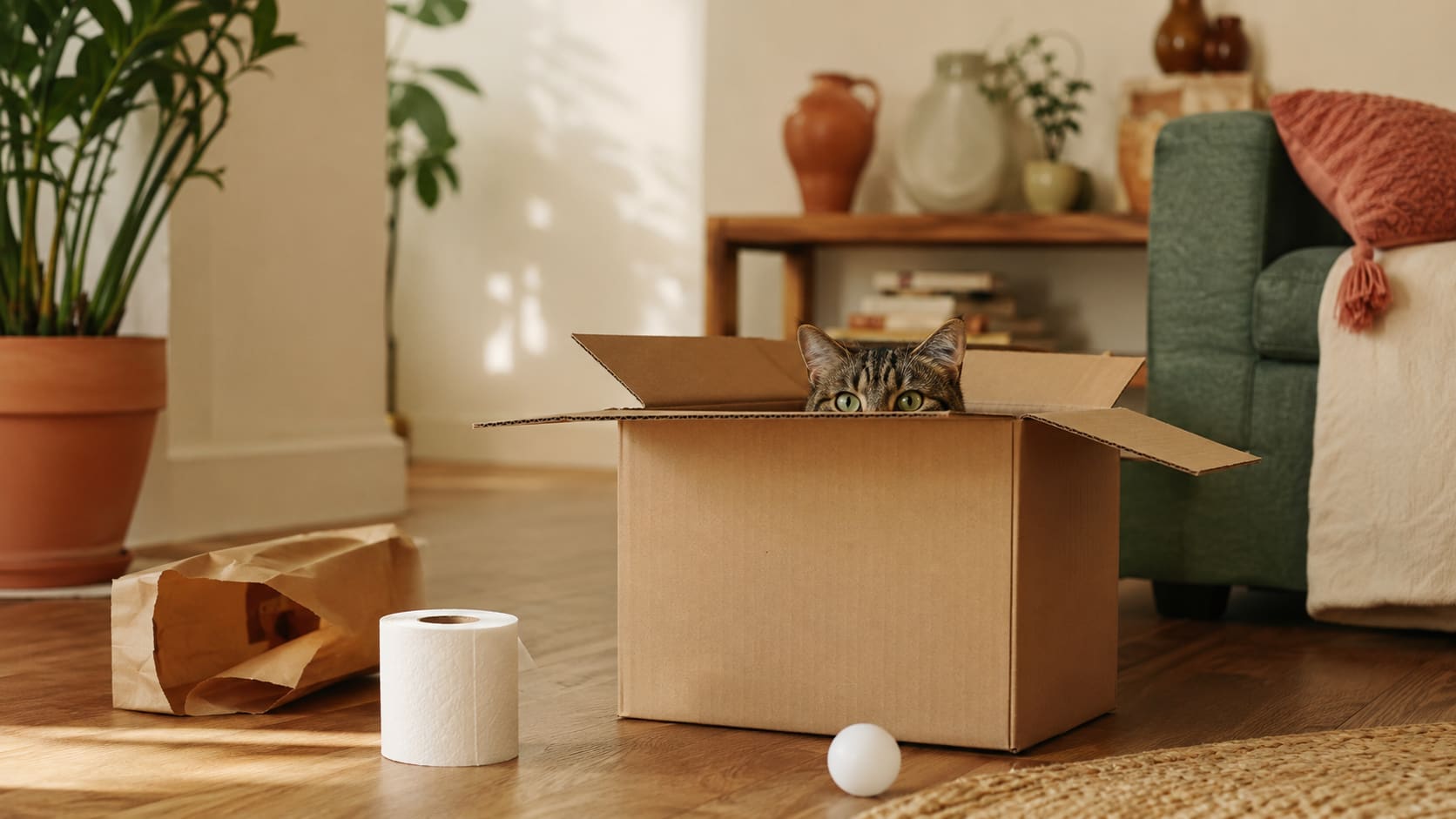
Every cat owner learns the same lesson eventually: you buy the toy, and your cat plays with the box it came in.
That is not your cat being ungrateful. It is your cat telling you exactly what enrichment actually is. Cats do not care what something cost. They care whether it offers novelty, a place to hide, a texture to shred, or food they have to work for. Almost all of that, you already have at home.
Here are 15 DIY enrichment ideas, grouped by what they tap into.
Foraging & Food Games
Making your cat work for food is the highest-impact enrichment there is, and it costs nothing.
1. The toilet roll puzzle. Tuck a few kibble pieces inside an empty toilet paper roll and fold the ends in. Your cat has to bat and dig to release them.
2. Muffin tin foraging. Drop a treat in each cup of a muffin tin, then cover some cups with balls or crumpled paper. Instant puzzle feeder.
3. Scatter feeding. Skip the bowl for one meal and toss the kibble across a clean floor or low-pile rug. Your cat now hunts across a territory instead of eating in ten seconds.
4. Egg carton dig box. Press treats into the cups of an egg carton and let your cat fish them out with a paw.
5. The frozen lick. Smear a little wet food or plain plumped tuna water into a shallow dish and freeze it. A long-lasting, low-mess treat for a hot afternoon.
If you want foraging that survives an enthusiastic cat and lasts longer than a paper roll, a purpose-built digger like the Catit Senses 2.0 Digger is the natural next step up from DIY.
Boxes, Bags & Hideouts
Cats need places to hide, perch, and ambush. Cardboard is the perfect material.
6. The box maze. Tape two or three boxes together and cut connecting holes. A tunnel system beats any plastic toy.
7. The paper bag. A plain paper grocery bag laid on its side is an instant cave. Cut the handles off first so they cannot loop around your cat’s neck.
8. Peekaboo box. Cut several paw-sized holes in a closed box and drop a ball or toy inside. Your cat fishes for it through the holes.
9. The box fort. Stack and offset a few boxes to make levels. Vertical space plus hiding equals a cat magnet.
10. DIY scratch surface. Glue or tightly wrap sisal rope, or even flattened corrugated cardboard, onto a sturdy board to make a scratcher for the cost of nothing.
Movement & Batting
For the chase instinct, you need things that roll, skitter, and are easy to bat.
11. Bottle caps and wine corks. Light, skittery, and unpredictable on a hard floor. Cats love them.
12. Ball in a dry bathtub. Drop a ping pong ball in an empty tub. The high sides keep it in play and the cat entertained for ages.
13. The sock kicker. Stuff an old sock with a little batting, sprinkle in some catnip or silvervine, and knot the end for a bite-and-bunny-kick toy.
14. The DIY wand. Tie a strip of fabric or a feather to a string on a stick. Use it only under supervision, and put it away after, since loose string is a hazard.
15. Ping pong ball. The classic. Lightweight, erratic, and almost impossible for a cat to fully control, which is exactly why it stays interesting.
To make any of the homemade toys above more enticing, especially for fussy cats, a sprinkle of catnip or silvervine can be the difference between ignored and irresistible.
A Note on Safety
DIY is brilliant, but supervise anything involving string, ribbon, rubber bands, or small swallowable parts, and throw a toy out the moment it starts shedding pieces. When in doubt, keep the string toys for interactive play only.
Where DIY Runs Out
Homemade enrichment covers novelty and foraging beautifully, and for most cats it is 80 percent of the job. The pieces it cannot easily replace are durable self-play and a steady supply of greens.
A simple cat grass growing kit gives indoor cats safe greens to nibble and a living thing to investigate, which is hard to fake with household items.
For the rest, pair your DIY setup with a couple of well-chosen basics. Our indoor cat enrichment ideas guide shows how the homemade and store-bought pieces fit together, and the best puzzle feeders roundup covers foraging that outlasts a toilet roll.
Curious which of these your cat actually engages with most? We’re building CatPlay, a simple app for tracking your cat’s daily play and enrichment so you can double down on what works.
Sources
This article cites 3 sources in the text. They are linked below.
- Indoor Pet Initiative — Cats (The Ohio State University College of Veterinary Medicine)
- Feline Environmental Needs and Enrichment (MSPCA-Angell)
- What Your Cat Needs to Feel Secure (Cat Friendly Homes)
Common questions
What household items make good cat toys?
Cardboard boxes, paper bags, toilet paper rolls, bottle caps, wine corks, an old sock, and a muffin tin all make excellent enrichment when used to encourage hunting, foraging, and hiding.
Are DIY cat toys safe?
Most are, with two rules: supervise anything with string, ribbon, or small parts that could be swallowed, and remove a toy once it starts breaking apart. Cut the handles on paper bags so they cannot loop around a neck.
How do I make a cat toy with things at home?
Start simple: cut a few holes in a box and drop a ball inside, hide treats in a muffin tin, or fold treats into a toilet paper roll with the ends tucked in. Foraging and hiding games beat anything store-bought for engagement per dollar.
The Indoor Cat Enrichment Starter Plan
A simple download with play, food puzzle, and routine ideas you can use this week.
No spam. Unsubscribe anytime. We respect your inbox.