Why Does My Cat Bite Me When I Pet Her? (Overstimulation Explained)
Your cat is not biting out of nowhere. Petting can tip into overstimulation fast. Here is how to read the warning signs and keep touch relaxed.
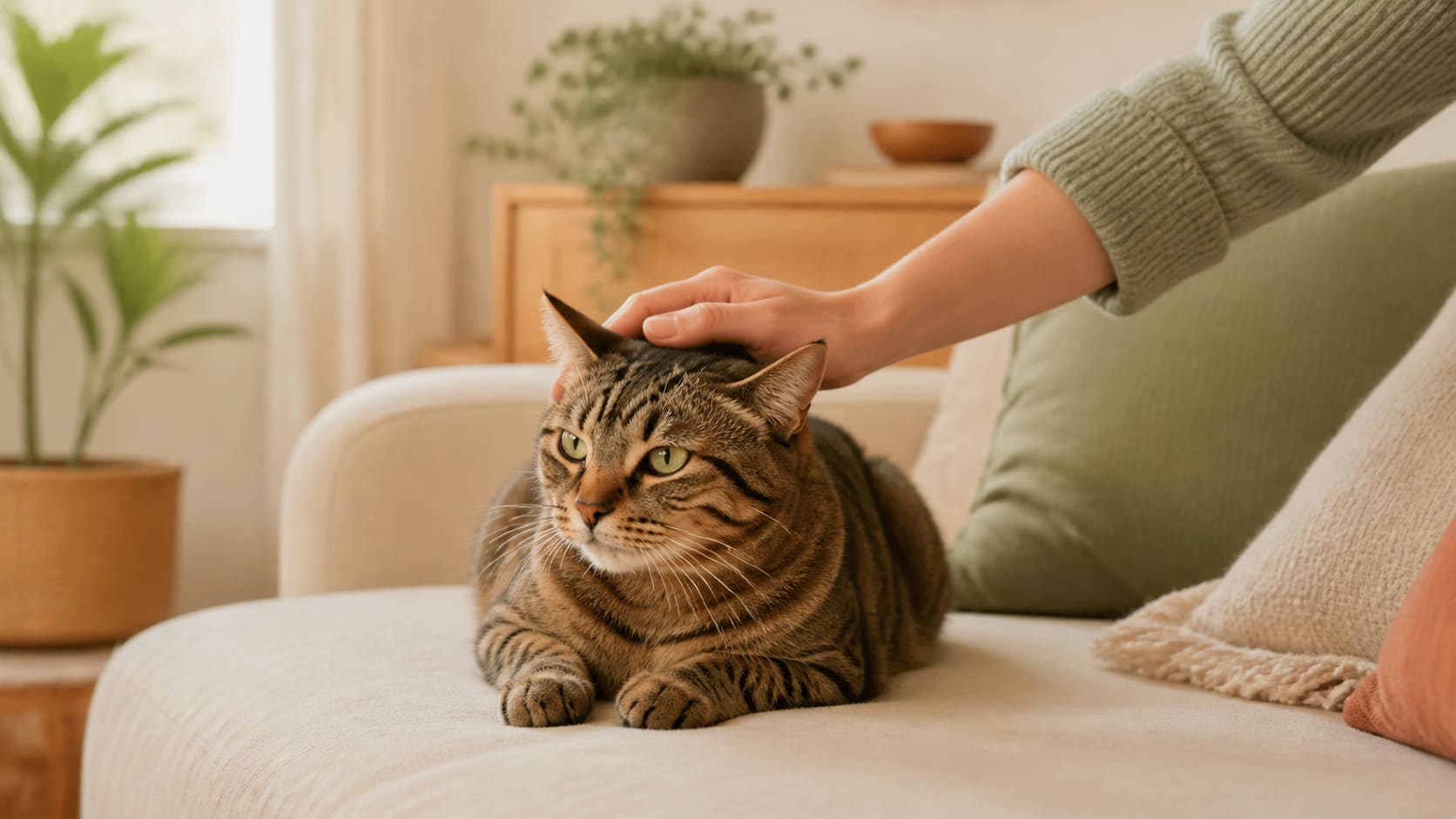
Your cat is purring. You’re petting her. Everything is fine.
Then she turns around and bites your hand.
No obvious buildup. No hissing. Just suddenly, the petting session is over and you’re staring at a tooth mark wondering what you did wrong.
You probably did not do anything wrong. But something changed for your cat. Petting can tip from pleasant to too much faster than people expect, and once you know the warning signs, the bites get much easier to prevent.
1. What’s Actually Happening
Cats experience touch differently from humans.
They have sensitive skin, and many cats have strict limits around repeated strokes, especially along the back, belly, and base of the tail. What starts as pleasant contact can cross into irritation or overstimulation. When it does, the cat’s nervous system may choose the fastest exit: bite, leave, or both.
Your cat is not being spiteful. She is overwhelmed or uncomfortable.
The difficult part is that the tipping point is not always obvious. The session may look calm to you, while your cat is already building tension under the surface.
What helps: Keep petting sessions short for now. Stop before your cat has to make the decision for you, and let her choose whether to come back.
2. The Warning Signs Right Before the Bite
Most people say the bite came out of nowhere. Usually it did not. The signals were just small.
In the 10 to 30 seconds before a bite, many cats show at least one of these:
- Tail flicking or lashing
- Skin twitching or rippling along the back
- Ears rotating backward
- A body that goes still in a tense way
- A head turn toward your hand
- Pupils getting larger
Any one of these is a stop signal. The moment you see it, stop petting, even if your cat was purring a second ago.
Purring can mean the session was good up to that point. It does not always mean “keep going.” Our guide to why your cat stares at you covers more body language cues if you want to get better at reading the whole cat.
What helps: Use a simple pause test. Pet for a few seconds, stop, then wait. If she nudges your hand or leans in, continue. If she looks away, sits still, or leaves, let that be the end.
3. Why Some Cats Hit the Limit Faster
Not all cats have the same tolerance for touch.
Early handling, genetics, stress, age, pain, and general anxiety can all change how quickly a cat reaches her limit. A cat who was not handled much as a kitten may only enjoy a few strokes. A cat with sore joints or skin discomfort may react sharply to touch that used to be fine.
Anxiety matters too. A cat who is frequently startled, under stimulated, or living with too much unpredictability may carry more baseline tension. That means extra sensory input, including petting, reaches the limit faster.
A low petting threshold is information, not defiance.
What helps: Add predictable play before cuddle time. A short wand session can burn off tension before you try to pet her. Go Cat Da Bird is a strong option because the feather movement gives many cats a complete chase and catch sequence.
4. The Spots That Make It Worse
Where you pet matters as much as how long you pet.
Most cats handle touch better around the cheeks, chin, forehead, and base of the ears. Those areas are closer to social grooming and rubbing zones. The belly, lower back, and base of the tail are much more sensitive for many cats.
A simple rule: stay above the shoulders until you know your cat’s limits clearly.
Some cats eventually tolerate more touch through slow, positive exposure. But if your cat has already bitten, sensitive areas are not the place to rebuild trust.
What helps: Offer your hand near her cheek and let her decide where contact happens. If she turns her head away or dips down, do not chase the pet.
5. How to Build a Better Petting Routine
The goal is not to stop touching your cat. The goal is to make touch predictable, short, and easy to leave.
Let her initiate. When she walks over, head bumps you, or rubs against your hand, the session usually starts on better terms than when you reach for her first.
Count a few strokes, then pause. If she stays soft and asks for more, continue. If she freezes, looks away, or shifts her body, stop.
Give her a clean exit. Cats are less likely to bite when they can leave without being held, blocked, or followed. A stable Feandrea 56.3-Inch Cat Tree near the couch gives her a nearby place to move when she is done.
What helps: End every session while it is still going well. That teaches your cat that petting does not have to become uncomfortable before it stops.
6. Mental Enrichment Lowers the Pressure
A bored or frustrated cat often carries more physical tension into everything else.
Daily play and foraging do not just make your cat tired. They give the hunting system something useful to do. When that energy has a proper outlet, your hand is less likely to become the target during petting.
A cat with enough outlets is often easier to touch calmly.
For independent enrichment, SmartyKat Hot Pursuit creates hidden prey movement, and Cat Amazing Puzzle Feeder gives your cat a foraging problem to solve. Our guide to interactive toys that actually work has more options by play style.
What helps: Pair petting with a better daily routine: one short wand session, one foraging meal, and a clear place to retreat.
7. When It Has Nothing to Do With Petting
Not every mid-session bite is overstimulation.
Some cats bite hands during petting because they have slipped into play mode. The clues look different: large pupils, grabbing with the front paws, kicking with the back legs, and chasing your hand as it moves away.
That is play aggression, not petting discomfort. The cause is usually too little prey style play elsewhere.
The fix for play biting is more wand time before petting, not simply shorter petting sessions.
If your cat also knocks objects off surfaces or ambushes your feet as you walk past, treat the biting as part of a larger play and enrichment pattern.
The Bottom Line
Your cat is not turning on you. She is telling you she has hit her limit, and in most cases she was trying to tell you a few seconds before the bite.
Learn the warning signs. Keep sessions shorter. Pet the safer zones first. Give her a clean way out.
Most cats that bite during petting improve when the routine changes enough that they never reach the tipping point.
Want help building a consistent daily play routine? We’re working on CatPlay, a simple app for tracking your cat’s play sessions, energy patterns, and behavior changes over time.
Sources
This article cites 3 sources in the text. They are linked below.
- Feline Behavior Problems: Aggression (Cornell Feline Health Center)
- Overstimulation to Petting (Wisconsin Humane Society)
- Feline Environmental Needs and Enrichment (MSPCA-Angell)
Common questions
Why does my cat bite me when I pet her?
Most mid-petting bites happen because the cat has become overstimulated, uncomfortable, or tense. The bite often feels sudden, but many cats give small warning signs first, such as tail lashing, skin twitching, tense stillness, or ears moving back.
Should I punish my cat for biting during petting?
No. Punishment usually increases stress and makes the pattern worse. Stop touching, give your cat space, and make future petting sessions shorter and easier to leave.
When should I call a vet about petting bites?
Book a vet check if the biting is new, escalating, paired with hiding or appetite changes, or happens when you touch a specific body area. Pain can lower a cat's tolerance for touch.
The Cat Behavior Decoder
A free PDF with the body language cues and behavior patterns worth noticing first.
No spam. Unsubscribe anytime. We respect your inbox.