How to Stop Your Cat From Scratching Furniture (For Good)
Your cat isn't scratching the couch out of spite. Scratching is a biological need — and the fix is redirecting it, not stopping it. Here's the three-step approach that actually works.
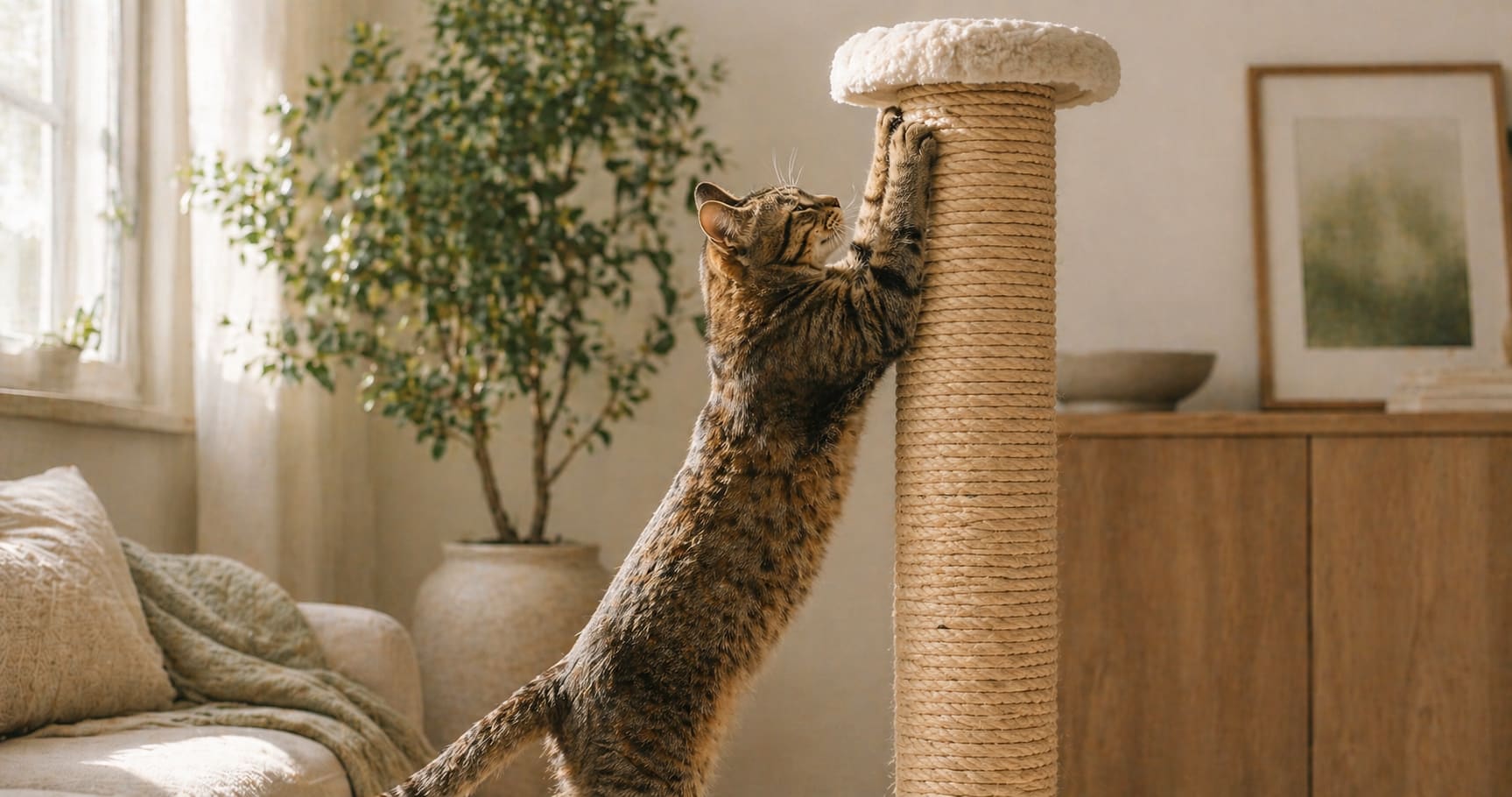
You hear it before you see it. That slow, deliberate drag of claws down your couch.
You’ve tried saying no. You’ve tried moving your cat away. You’ve tried the scratching post gathering dust in the corner. And yet — the couch continues to lose.
Here’s the thing: scratching isn’t a behavior problem. It’s one of the most normal things a cat does, right up there with sleeping and hunting. The goal isn’t to stop your cat from scratching. It’s to stop them from scratching your furniture specifically. Those are very different problems with very different solutions.
Why Cats Scratch (And Why You Can’t Just Make Them Stop)
Scratching does three jobs for your cat at once.
It conditions their claws by pulling off the outer sheath. It leaves visible and scent marks that communicate territory — cats have scent glands in their paw pads. And it’s a full-body stretch for the muscles along their back and shoulders, especially after sleeping.
Your cat isn’t scratching your couch to spite you. They’re meeting a biological need. The couch just happens to have the right texture, height, and location.
This matters because punishment doesn’t fix anything here. Spraying your cat, clapping loudly, or physically moving them away might stop the behavior in that moment, but it doesn’t redirect the need. They’ll go back as soon as you leave the room, or find a different piece of furniture.
What actually works is giving them something better to scratch than what they’ve chosen.
The Real Reason Their Scratching Post Isn’t Working
Most cats ignore scratching posts. But the post is usually the problem, not the cat.
The most common mistakes:
It’s too short. Cats scratch to stretch. If the post doesn’t let them fully extend their front legs and back at the same time, it doesn’t feel satisfying. Most cheap posts are 18-24 inches. Most cats need at least 28-32 inches of usable height.
It’s too wobbly. If the post tips or sways when your cat pushes against it, they’ll stop immediately. Cats need resistance — they’re pulling their claws through material, and a wobbly post gives them nothing to pull against.
It’s covered in carpet. Carpet scratching posts feel similar to, well, carpet — which means your cat doesn’t learn that soft woven surfaces are off-limits. Sisal rope or sisal fabric is more satisfying to scratch and creates a clearer distinction from your furniture.
It’s in the wrong room. More on this in a moment.
The SmartCat Ultimate Scratching Post gets this right: it’s 32 inches tall, covered in sisal, and has a weighted base that doesn’t tip. It’s the most consistently recommended tall post for a reason, and at around $50 it lasts far longer than the cheap ones that fall apart in three months.
Put the Post Exactly Where They Already Scratch
This is the step most people skip, and it’s the most important one.
Your cat chose your couch because of its location — probably in a main room, near where you spend time, and visible to anyone who enters the space. Scratching is partly territorial marking. Your cat wants their marks to be seen.
Move the post directly next to the piece of furniture they’re scratching. Not across the room. Not in a corner. Right next to it, touching if possible.
Once your cat starts using the post consistently — usually within one to two weeks — you can begin moving it a few inches further away every few days. Slow is the key word. Rushing this is how cats end up ignoring the post again.
If your cat scratches in multiple spots, you need a post in each location. One post in the living room doesn’t help if they also scratch the bedroom doorframe.
For cats that already like to climb, a Feandrea Cat Tree with multiple sisal-wrapped columns gives them scratching options and vertical space in one unit. Cats that have claimed a cat tree tend to be significantly less interested in furniture, because the tree already serves as their territory.
Make the Furniture Less Appealing
While your cat is learning to use the post, cover the spots they’ve been scratching.
Double-sided tape is the simplest option. Cats hate the sticky feeling on their paws. One or two strips over the scratched area is usually enough to redirect them — they look for a different surface, which is ideally the post you’ve placed right next to it. You can remove the tape once the habit has shifted, usually after a few weeks.
You can also use a plastic furniture protector (sometimes called a scratch shield) or aluminum foil in the short term. The goal is temporary redirection, not permanent coverage.
Don’t use chemical sprays near where your cat eats or sleeps. Most deterrent sprays work, but some cats find the smell aversive enough to avoid the whole area rather than just the couch.
Keep Their Nails Trimmed
Regular nail trims don’t stop scratching — but they do reduce the damage significantly.
Trimming removes the sharp tip of each claw, which is the part that catches and tears fabric. A cat with recently trimmed nails can still go through the scratching motions, but the impact on your furniture is much lower while you work on redirecting the behavior.
Every two to three weeks is a reasonable frequency for most cats. If your cat resists nail trims, short handling sessions with a treat reward are more effective than trying to do all ten claws at once while they’re struggling.
What helps: The Picky zoom 2-in-1 Nail Clippers and Grinder gives beginners two options in one tool: clipping for a small clean trim, grinding for gradual smoothing, plus a safety guard and LED light. It does not make nail trims magically easy. It just gives you a more controlled setup if you go slowly and stop before your cat is overwhelmed.
Give Them More to Do
A bored cat is more likely to scratch problematically.
Scratching that happens in sudden intense bursts — especially in the early morning or late evening — is often a sign of excess energy with no good outlet. If your cat is under-stimulated, adding regular play sessions before the times they usually scratch can reduce the intensity.
Two ten-minute play sessions a day, done consistently, change more behavior than any deterrent product. A wand toy like Go Cat Da Bird is the most effective option for burning off that restless energy — the feather moves like real prey and pulls out the full hunting sequence. See our guide to interactive toys that actually work for more options by play style.
If your cat’s scratching seems tied to stress rather than boredom — it spikes after visitors, after loud disruptions, or after something in the home changed — check our indoor cat enrichment ideas for ways to lower their baseline anxiety.
The Bottom Line
You can’t train a cat not to scratch. But you can train them where.
The three-step approach that actually works:
- Give them a tall, stable sisal post and put it right where they currently scratch
- Cover the furniture temporarily to redirect them while they’re learning
- Make sure they have enough play and stimulation so scratching doesn’t become the main outlet for energy
Most cats shift within two to four weeks when all three are in place at the same time. The key word is all three — doing one or two while skipping the third is usually why the furniture keeps losing.
Trying to build a more consistent routine for your cat? We’re building CatPlay — a simple app for daily play habits, energy tracking, and spotting behavior shifts before they become problems.
Sources
This article cites 3 sources in the text. They are linked below.
- Feline Scratching Behavior and the Effects of Declawing (FelineVMA)
- Meeting the Physical and Emotional Needs of Indoor Cats (FelineVMA)
- Scratching: Normal Feline Behavior (Cat Friendly Homes)
Common questions
Why does my cat scratch the furniture instead of the scratching post?
Usually because the post is the wrong height, too wobbly, or in the wrong location. Cats scratch to stretch and mark territory, so the post needs to be tall enough (28+ inches), stable, sisal-covered, and placed directly next to the furniture they're already using.
Will double-sided tape damage my furniture?
Most furniture-safe double-sided tape leaves no residue when removed after a few weeks. It works as a short-term deterrent while your cat learns to use the post, not as a permanent solution.
How long does it take to redirect furniture scratching?
Most cats shift within two to four weeks when a tall sisal post is placed next to the scratched furniture and the furniture is temporarily covered. The key is doing all three steps at the same time.
Should I declaw my cat to stop the scratching?
No. Declawing is an amputation of the last bone of each toe and is associated with long-term pain, litter box avoidance, and increased biting. It is banned in many countries. Regular nail trims and proper post placement are effective and humane alternatives.
The Cat Behavior Decoder
A free PDF with the body language cues and behavior patterns worth noticing first.
No spam. Unsubscribe anytime. We respect your inbox.