Why Your Bored Cat Destroys Everything (Blinds, Plants & the Fix)
Knocked plants, chewed blinds, shredded furniture: destructive cats are usually bored, not bad. Here is what each behavior means and how to redirect it for good.
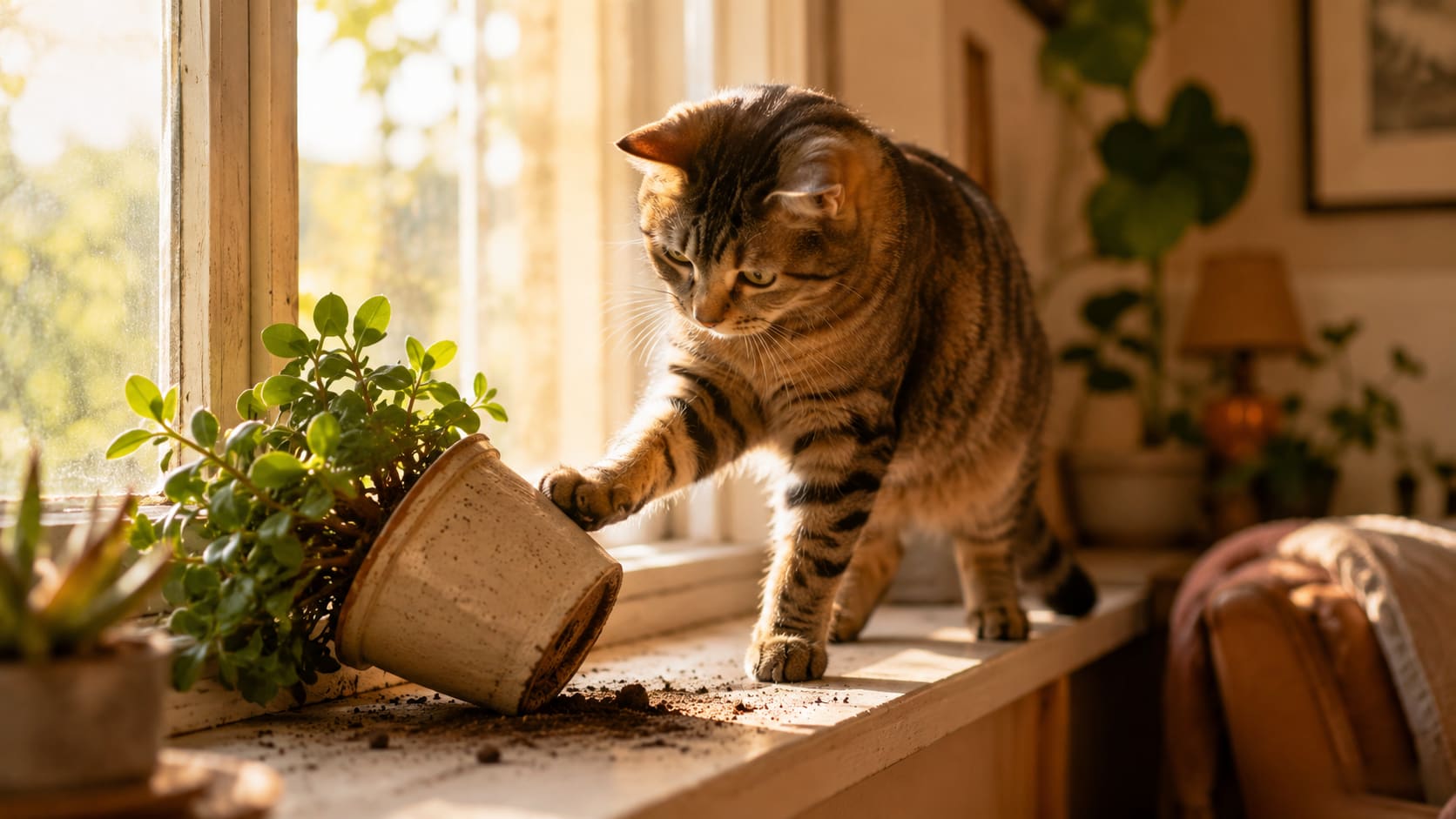
You come home to a potted plant on its side, soil across the floor, and a cat sitting calmly nearby as if it had nothing to do with anything. Or you wake to the rattle of claws working their way down the blinds. It is easy to read this as your cat being difficult.
It almost never is. Destruction is communication. A cat that shreds, knocks, chews, and digs is a cat telling you, in the only language it has, that something it needs is missing, usually an outlet for energy, hunting drive, or simple curiosity. Cats do not destroy out of spite. They destroy because the behavior works: it is interesting, it gets a reaction, or it scratches an itch nothing else is scratching.
Once you read each behavior as a request, the fixes get obvious. Here is what your cat is actually saying, and what to do about it.
”I Have Nothing to Hunt” — Knocked Plants and Swept Shelves
Batting objects off a surface is play behavior with a hunting root. The object moves, makes a sound, maybe gets a reaction from you, and that is genuinely rewarding to a cat with no real prey to chase.
The fix is two-sided: remove the reward and supply a better one. Secure the items your cat targets, and pour the hunting drive into real play so the shelf stops being the only game in town.
What helps: A little museum putty under vases, frames, and pots anchors them so the “swat and watch it fall” payoff disappears. For the full breakdown of this specific behavior, see why your cat knocks things off tables.
”I Need to Scratch Something” — Shredded Furniture and Carpet
Scratching is not optional for cats. It conditions claws, marks territory, and stretches the body. If the only things in scratching range are your sofa and your carpet, that is what gets used. This is not destruction so much as a misdirected need.
The answer is rarely “stop.” It is “scratch here instead,” with an outlet good enough to win over the couch: tall enough for a full stretch, sturdy enough not to wobble, and placed where your cat already wants to scratch.
What helps: A tall, rigid post like the SmartCat Ultimate Scratching Post lets a cat stretch to full height on a stable surface, which is exactly what the arm of your sofa was standing in for. The complete redirection method is in how to stop your cat scratching furniture.
Nails are the support layer here, not the whole fix. Trimming the sharp tips reduces fabric damage while the new scratching habit takes hold. The Picky zoom 2-in-1 Nail Clippers and Grinder is useful if you want one tool that can clip and smooth gradually, with a safety guard and LED light. Go claw by claw, reward heavily, and stop before the session turns into a fight.
”I Want to Chew Greens” — Eaten Houseplants
A cat that chews leaves is often after plant matter for its own sake, cats nibble greens to aid digestion. The problem is that many common houseplants are toxic, so this one carries real risk, not just mess.
Give your cat a safe target to chew and the houseplants become less of a draw. And check every plant in your home against a reliable toxic-plant list, lilies in particular are dangerous to cats.
What helps: A tray of cat grass gives your cat a safe, satisfying thing to nibble and redirects the chewing instinct away from your pothos. Grow it where your cat can reach it easily so it competes with the off-limits plants.
”Make This Spot Boring” — The Repeat-Offender Targets
Some targets get hit again and again: the same corner of the rug, the same blind, the same chair leg. For these specific repeat offenders, it helps to make the spot itself unappealing while the better outlets take hold.
Deterrents work because cats avoid surfaces that feel or smell wrong. Used alongside a real outlet, not instead of one, they break the habit loop on a particular target.
What helps: A citrus-based deterrent spray on a repeat-target surface makes that spot unpleasant enough that your cat moves on, especially once there is a sanctioned scratching or play outlet nearby. Never spray it near food, water, or your cat’s resting areas.
The Root Cause: Drain the Tank
Every fix above works far better on a cat whose energy already has somewhere to go. Most destruction lives in the low-stimulation windows, while you are at work and late at night, so those are the windows to load.
A reliable daily pattern:
- Morning: 10 to 15 minutes of hunt-style wand play before you leave.
- While you are gone: a foraging meal, a self-play toy, and a window view so boredom never gets the chance to build.
- Evening: a second play session ending in a catch and a meal.
If you want this built out fully, signs your cat is bored helps you confirm boredom is the cause, and 20 indoor cat enrichment ideas gives you the outlets to fill the day with.
For cats in small homes, add height before buying more floor toys. A wall route such as the Lynadri Cat Wall Shelves 5-in-1 gives a bored cat more territory without taking up the room. Steps, a condo, scratching surfaces, and resting points create a place to climb, watch, and decompress instead of using your shelves and blinds as the obstacle course.
What Does Not Work
Two things to drop, because they make destruction worse, not better:
- Punishment after the fact. Your cat cannot connect a scolding to something it did an hour, or even a minute, ago. All it learns is that you are sometimes scary, which adds stress, and stress fuels more destruction.
- Removing outlets without replacing them. Taking away the scratched chair without offering a better post just sends your cat to the next piece of furniture. Always redirect, never just deny.
Destruction is frustrating, but it is also the easiest kind of cat problem to solve, because it comes with a clear message attached. Give the underlying need a better address and the blinds, the plants, and the furniture stop being collateral damage.
Not sure whether it is boredom, energy, or something else driving the mess? We’re building CatPlay, a simple app for tracking your cat’s daily behavior so you can see the pattern behind the destruction and what finally stops it.
Sources
This article cites 3 sources in the text. They are linked below.
- Destructive Behavior in Cats (ASPCA)
- Feline Environmental Needs and Enrichment (MSPCA-Angell)
- Toxic and Non-Toxic Plants List (ASPCA)
Common questions
Is my cat destroying things out of spite?
No. Cats do not act out of spite or revenge. Destructive behavior is almost always an unmet need, usually boredom, excess energy, or a missing outlet like an appropriate scratching surface. Reading the behavior as a request rather than an attack is what makes it fixable.
How do I stop my cat from destroying things while I am at work?
Combine three things: drain energy with morning play, give legitimate outlets like a tall scratching post and foraging toys, and make the targets less appealing with deterrents or by removing access. Punishment after the fact does not work because cats do not connect it to the earlier act.
Why does my cat destroy things only at night or when I leave?
Those are the low-stimulation windows. A cat with nothing to do during your absence or in the quiet hours redirects that energy into whatever is available, blinds, plants, paper. The fix is loading those specific windows with self-play and foraging outlets.
The Cat Behavior Decoder
A free PDF with the body language cues and behavior patterns worth noticing first.
No spam. Unsubscribe anytime. We respect your inbox.