Cat Window & Balcony Safety: Preventing Summer Falls
Open windows are a summer necessity and a hidden danger for cats. Here's how to cat-proof windows and balconies, what 'high-rise syndrome' really is, and the simple fixes that prevent falls.
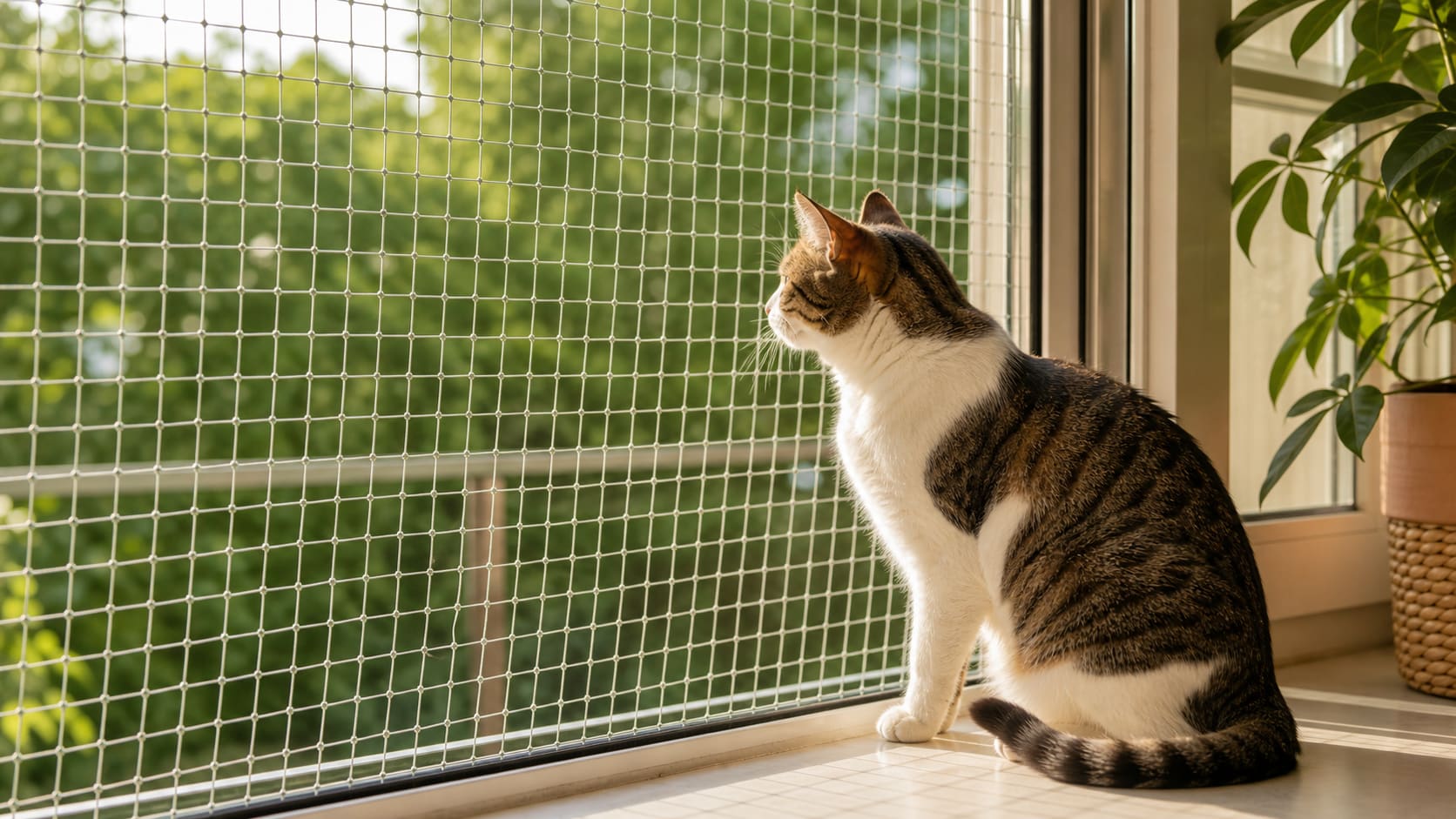
Summer means open windows, and open windows mean a risk most cat owners underestimate. Vets see a seasonal spike in cats falling from windows and balconies every summer — the pattern is so consistent it has a name, high-rise syndrome. The reassuring part is that nearly every one of these accidents is preventable with a bit of cat-proofing. Here is what actually keeps a cat safe when the windows are open.
Why Cats Fall in the First Place
Cats are not clumsy, and they do not “decide” to jump. Falls happen because a cat is utterly absorbed in something outside — a bird, a fluttering leaf, an insect — and a hunting cat in full focus loses track of the edge. A sudden lunge at prey, a slip on a narrow sill, a doze that turns into a roll, and a cat that was perfectly safe a second ago is over the edge.
The myth that cats “always land on their feet” makes this worse, because it leads owners to relax. Cats do have a righting reflex, but it does not prevent serious injury, and it can fail entirely on short falls where there is no time to rotate.
Insect Screens Are Not Cat Screens
The most common and dangerous assumption is that a standard window screen will hold a cat. It will not. Insect mesh is built to stop bugs, not to take the weight of a cat leaning, climbing, or pouncing, and it pops out of the frame with surprisingly little force. A screen that looks secure can give way the one time your cat throws itself at a passing fly.
If your safety plan is “the screen is in,” your cat is not actually protected.
How to Cat-Proof Windows and Balconies
You have a few good options, from simple to thorough:
Secured safety mesh. A purpose-made cat window safety net fixes over the opening and is strong enough to hold a cat’s weight, letting you keep the window wide open for airflow without the risk. It is the most flexible fix for both windows and balconies.
Adjustable window guards. For windows you open partway, an adjustable self-adhesive window guard blocks the gap a cat could slip through while still letting air in.
Limit the opening. Many windows can be opened just a few inches — too narrow for a cat to fit — and locked there. Top-opening (awning) windows are safer than ones a cat can reach the sill of.
Balconies need full enclosure. A balcony is not safe with a railing alone; cats fit through and over gaps that look far too small. Netting or mesh across the whole space is the only reliable answer, and never leave a cat on an open balcony unsupervised.
Keep the View Without the Risk
Here is the good news: you do not have to choose between a safe cat and a happy one. Cats need that window view — it is genuine enrichment — so the goal is to keep the entertainment and remove the danger.
A secure screen plus a stable perch set back from the opening gives your cat the whole show safely. A window perch positioned behind safety mesh lets your cat lounge, watch, and chatter at birds with no way to tumble out. For more on why that view matters so much, see our guide to Cat TV and window perches.
The Summer Safety Checklist
Before you start leaving windows open for the season:
- Test every screen — if it pops out under hand pressure, it will not hold a cat.
- Install secured mesh or guards on the windows your cat can reach.
- Fully enclose any balcony, or keep it off-limits.
- Set perches back from open windows so a lunge does not end at the edge.
- Supervise until you are sure the setup holds.
Window safety pairs naturally with the question of outdoor access — if your cat is desperate to get outside, there are safe ways to allow it, covered in letting your cat outside safely. And for the rest of the season’s care, see how to keep your cat cool in hot weather.
We’re building CatPlay, a simple app for tracking your cat’s daily routine and habits, so you always know what your indoor cat is up to.
Sources
This article cites 3 sources in the text. They are linked below.
- High-Rise Syndrome in Cats (ASPCA)
- Keeping Cats Safe at Home (International Cat Care)
- Feline Injury Prevention (Cornell Feline Health Center)
Common questions
What is high-rise syndrome in cats?
High-rise syndrome is the pattern of injuries vets see when cats fall from windows and balconies, most often in summer when windows are open. Common injuries include broken jaws, chest trauma, and fractured limbs. It's well documented enough to have its own name, and it's almost entirely preventable.
Do cats always land on their feet?
Cats have a righting reflex that helps them rotate mid-air, but it does not make them fall-proof. They can still suffer serious injuries, and short falls can be worse because there isn't enough time to right themselves. Never rely on the reflex as a safety measure.
Are screens enough to keep a cat safe?
Standard insect screens are not. They're designed to keep bugs out, not to hold a cat's weight, and they pop out easily when a cat leans or pounces. You need a secured, cat-rated screen or guard, properly fixed to the frame, to make a window safe.
The Summer Cat Care Checklist
A simple checklist for heat, hydration, grooming, and open-window safety on hot days.
No spam. Unsubscribe anytime. We respect your inbox.